Scientists uncover new details about rapid shifts in Earth's magnetic poles
An international research team has discovered that Earth's magnetic poles may have switched places more frequently in the past than previously thought.
 💡Tech
Photo: UNIAN
Key points
- Earth's magnetic poles shifted faster in the past
- Limestone study in China spanned millions of years
- Inversion acceleration could be linked to Pangea
- Field changes potentially affected the ozone layer
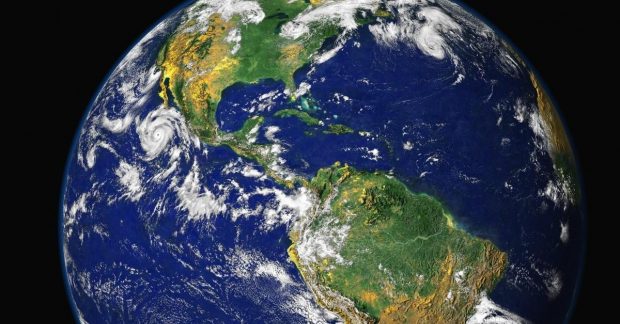
The stability of our planet's magnetic field has once again drawn attention from the scientific community following new geological findings. Experts note that Earth's geological history includes numerous periods of massive transformations where the north and south magnetic poles swapped places. Such processes create a unique record of changes deep within our planet and help better understand the dynamics of its internal layers.
New data on geomagnetic shifts
A group of scientists led by researchers from the Chinese Academy of Sciences focused on studying limestone rocks located near the city of Liuzhou. By analyzing sedimentary layers, the researchers reconstructed the chronology of magnetic polarity reversals spanning millions of years after the end of the Kiaman Superchron. It turned out that over time, the frequency of magnetic field reversals increased significantly, reaching approximately 11 cases per million years.
Researchers suggest that this acceleration might have been triggered by tectonic processes, particularly the formation of the ancient supercontinent Pangea. The sinking of cold oceanic crust slabs into the mantle could alter heat dissipation from Earth's core, which generates the magnetic field. At the same time, specialists emphasize that this remains a hypothesis requiring further verification.
The weakening of the magnetic field during transitional periods could have led to the temporary destruction of the ozone layer and increased ultraviolet radiation.
Additionally, scientists highlight potential ecological consequences that such geomagnetic fluctuations had on the biosphere in the past. These global shifts serve as a reminder of the complexity and interconnection of all processes on Earth, from deep mantle layers to the atmosphere.
Source UNIAN — unian.ua/science/pivnichniy-polyus-zemli-mozhe-stati-pivdennim-usog… ↗
Read next
 🛡️Security
Russian corvette 'Merkury' reportedly hit by Ukrainian drones in Libya
An explosion occurred on a Russian warship in Benghazi, which sources suggest may have been caused by an attack from maritime drones.
 🧠AI Analysis
Russia tests NATO defense algorithms through airspace violations, says Ukrainian colonel
Retired Ukrainian Colonel Dmytro Kashchenko stated that Russia uses missile and drone incidents to test the Alliance's readiness.
 🎓Education
Unique agricultural achievement: resident of Cherkasy region grows a 350-kilogram pumpkin
Oleksii Buriachenko from Smila grew a giant 350 kg pumpkin in his garden and gave it away to the local community for free.
 🏛️Politics
US National Intelligence Director: Putin is not a friend of America in the context of the war in Ukraine
US National Intelligence Director Jay Clayton clearly distinguished between diplomatic contacts with Russia and the stance on the war, emphasizing the lack of friendly re…
 👥Society
Tragedy in Dymer: Death toll from Russian attack rises to eight
Rescuers have recovered the eighth body from the rubble of a destroyed building in Dymer, Kyiv region.
 👥Society
Clashes at the Kyiv Pechersk Lavra: police launch investigation
Police intervened in a dispute between individuals at the historic site, which arose from disagreements over the use of religious buildings.